
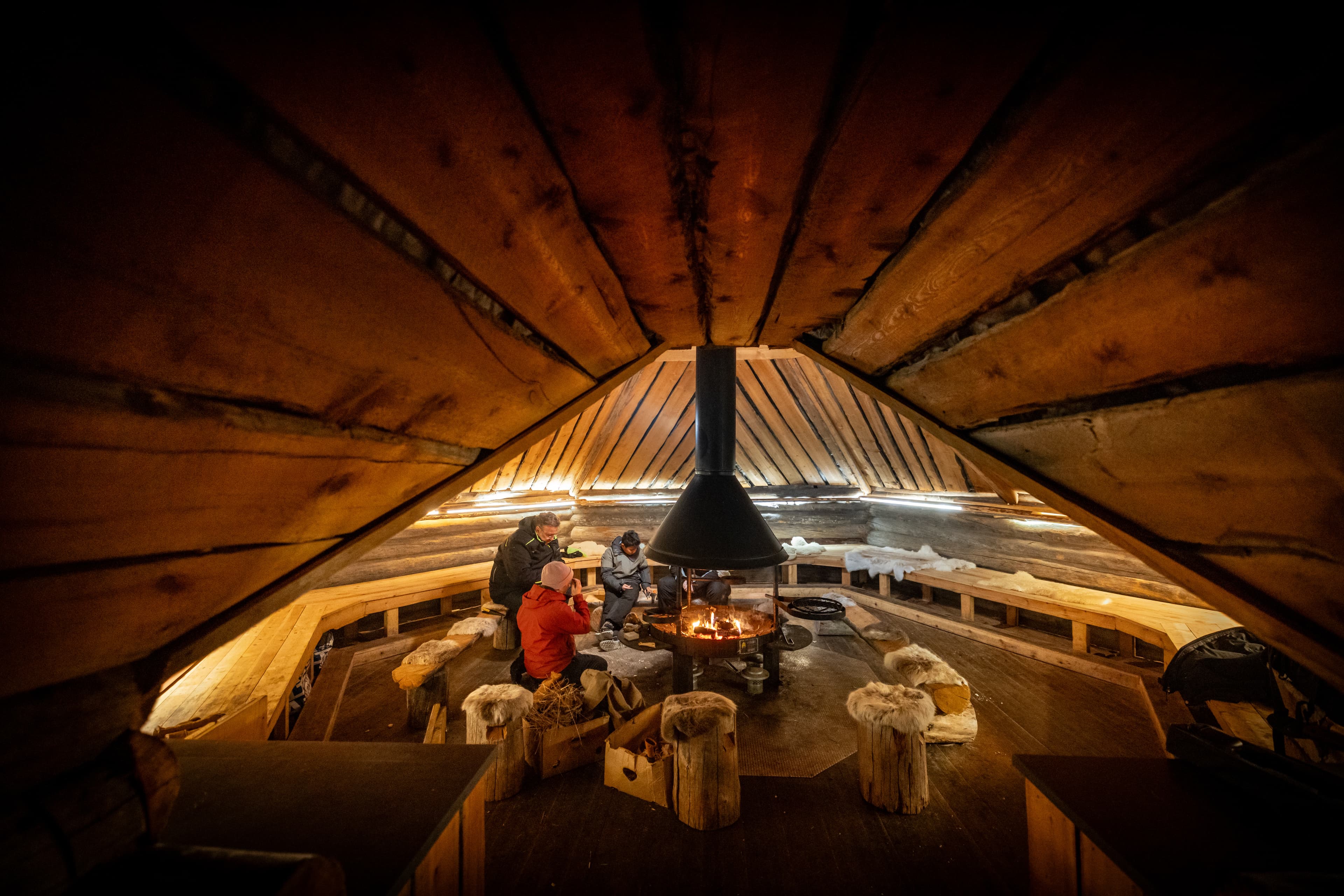
January in Finnish Lapland: the longest aurora nights, deepest snow, and fewest crowds of winter. Discover Pyhätunturi in January, the month arctic winter is most itself.
Lapland in January: The Month the Winter Finds Its Rhythm at Pyhätunturi
Lapland in January is not the most advertised month in the tourism brochures, that distinction belongs to December, with its Christmas associations and first-snow imagery. But for travellers who actually want to experience Finnish Lapland at its most elemental, coldest, darkest, most auroras, deepest snow, fewest people - January is the month that delivers. At Pyhätunturi, set inside the Pyhä-Luosto National Park roughly two hours north of Rovaniemi, January offers the undiluted core of arctic winter: temperatures that make the cold real, darkness that makes the aurora undeniable, and a landscape so deeply frozen and silent that it can take a full day before you understand what you are looking at.
Aurora Borealis in January: The Longest Dark of Winter
January is the single best month in the year for aurora probability at Pyhätunturi. The reason is simple: of all the months when geomagnetic activity is sufficient for northern lights displays, January provides the most hours of complete darkness per night. In early January, the sun barely rises at this latitude, a brief twilight of one to two hours is all the daylight there is, the tail end of the polar night that blankets the far north from early December. By mid-month the sun begins returning, but it skims just above the horizon for a few pale hours before darkness reclaims the sky. Aurora windows in January can run from 2 PM to 9 AM, close to nineteen hours of potential display time per night.
For the aurora floating experience at Pyhätunturi, January is the month when every element aligns. The lake ice has been building since November and holds the activity corridor with complete reliability. The surrounding national park is entirely dark, no street lighting, no ski-slope floodlights cutting across the view, so even a modest KP3 display puts on a proper show overhead. Guests who have seen the northern lights elsewhere, at Tromsø or Abisko or Rovaniemi, consistently describe the Pyhätunturi January aurora as different in character. Not because the phenomenon is different, but because the context is: you are not watching from a warm hotel terrace. You are horizontal on a frozen lake, forty centimetres of ice beneath you and nothing above but open sky doing something that does not have a normal human category.
Why the Post-Christmas Quiet Makes a Difference
December in Lapland, for all its beauty, carries crowds. The school-holiday families, the Christmas-Eve aurora seekers, the once-in-a-lifetime visitors. They fill small-group sessions to capacity and push booking lead times to four or five months in advance. By the second week of January the seasonal pressure is completely gone. Sessions run at their natural size. Guides can stay longer at a particularly good aurora spot or extend an ice fishing session when the fish are active. The national park trails, not groomed, not signposted, just old forest and frozen fell - are entirely empty. Pyhätunturi in January is not a destination you visit so much as a place you find yourself inside.
Ice Activities in January: When the Freeze Is Complete
January marks the point at which the ice of the Pyhä-Luosto National Park lakes has been building since October and has reached a thickness that makes every ice-based activity fully operational. The ice floating experience runs from December onward, but January offers a specific quality: the ice is thick, structurally stable, and visually remarkable. Look down through it on a clear, still day and you can sometimes see the dark water of the lake trapped beneath the surface. Look up on a clear January night and you see the aurora or an impossible density of stars. The contrast between the solidity beneath and the theatre above is what guests try to describe and usually give up on.
For arctic ice fishing, January is when the fish are deep and the challenge is genuine. Perch and trout are sluggish in the coldest water but still active enough for a guided session to yield results, particularly with a local guide who knows which lakes hold fish in deep winter. A January ice fishing morning follows a specific rhythm: the 9 AM twilight light on untracked snow, the drilling of holes by headlamp, the silence of a lake that has been frozen solid since the end of October. This is Finnish ice fishing in its most honest form. You can combine it with a bushcraft afternoon and an evening aurora float to make a single day that covers the full range of what January at Pyhätunturi offers, the fishing and ice floating combination is particularly well-suited to January's long, dark evenings.
Bushcraft in January: Arctic Skills in the Real Cold
There is a version of bushcraft that happens in mild autumn woodland, with comfortable temperatures and forgiving conditions. And then there is arctic bushcraft in January at Pyhätunturi, where temperatures of −20°C to −28°C mean that every skill carries immediate stakes. Fire-making in these conditions is not a demonstration. It is a necessity. Shelter assessment is not an exercise in woodland aesthetics. It is the difference between warmth and a serious cold injury. This is the context in which traditional Finnish and Sámi wilderness skills were developed, and it is the context in which learning them actually makes sense.
The January forest at Pyhätunturi is extraordinarily still. Snow loads the branches of the ancient spruce so heavily that the canopy closes above you, diffusing the pale light of the short winter day. The air is dry and sharp. Sounds carry differently, the crack of a branch under snow, the distant percussion of a woodpecker, the near-silence of wind through pine needles. Guests who come expecting a comfortable outdoor workshop and encounter the real January cold of Finnish Lapland sometimes take a moment to adjust. Most describe it later as the point the trip became something they will actually remember.
Snow Surfing and Winter SUP in January
January at Pyhätunturi brings the snowpack to conditions ideal for the more physical surface activities. The Snow Surf Day Trip benefits from January's deep, consolidated powder, typically 60 to 90 cm in the open fell terrain above treeline, and from a cold that keeps the snow dry and fast. This is not groomed piste; it is off-piste descent through open fell and ancient forest, on hand-shaped boards, in conditions that look precisely like what they are: deep winter in Finnish Lapland.
For travellers drawn to water in its rarer January forms, winter SUP is available when open stretches of moving water persist on local rivers and channels despite the surrounding freeze. The thermal dry suit technology that makes ice floating possible is here applied to paddleboarding through an arctic landscape with snow on its banks and ice forming at its edges. The combination of technical warmth and physical effort makes winter SUP a natural fit for active visitors who find passive cold experiences insufficiently demanding.
Why January at Pyhätunturi, Rather Than Rovaniemi or Levi
Rovaniemi and Levi are excellent destinations for Lapland's mainstream winter experience, accessible, well-serviced, reliably good. But both carry the infrastructure of popularity: tourist streets, large safari groups, activity queues. In January, the gap between those destinations and Pyhätunturi widens. Pyhätunturi, 130 km north of Rovaniemi and accessible by road in two hours, sits deep inside a national park with no town centre, no high-rise hotels, no commercial strip. The nearest settlement, Pelkosenniemi, is a small village twenty minutes away. There is nothing to do at Pyhätunturi in January except be in Finnish Lapland, which turns out to be exactly what the kind of traveller who finds January more interesting than December came for.
Practical Information: Visiting Pyhätunturi in January
Temperatures and Conditions
January is the coldest month of the year at Pyhätunturi. Daytime temperatures typically range from −15°C to −25°C, with cold snaps regularly reaching −28°C to −32°C. These conditions require proper layering, merino wool base, insulating mid-layer, windproof outer - and footwear rated to −30°C or below. Thermal dry suits are provided for all water activities; clothing guidance for land activities is included with booking confirmation.
Daylight and Aurora Windows
Early January at Pyhätunturi (67°N) sees one to two hours of weak twilight per day, the polar night has technically ended but the sun barely clears the horizon. By mid-January, daylight extends to three to four hours of low, raking golden light that turns the snow and birch forest vivid for a short, intense window. By late January, five to six hours of pale winter sun return. Aurora windows in early January can run for nineteen or more hours of darkness; by month's end, complete darkness lasts five to seven hours. Aurora floating sessions are scheduled accordingly.
Getting to Pyhätunturi
Pyhätunturi is two hours by road from Rovaniemi Airport, which has direct flights from Helsinki year-round and seasonal charter connections from London, Amsterdam, and other European cities through the winter season. Transfers from Rovaniemi can be arranged on request. January driving within and around the national park requires winter-rated tyres; hire car bookings should specify arctic specification.
Booking January Activities
January is quieter than December and February but sessions still run at limited capacity to preserve the small-group character that defines the Pyhätunturi experience. Book four to six weeks in advance for preferred dates. A typical January itinerary combines an aurora floating session on the first evening, ice fishing the following morning, bushcraft and open-fire lunch in the afternoon, and a final sunset snow surf or snowshoe walk on the last day. Bespoke itineraries built around your travel dates are available on request.
January in Finnish Lapland: The Core of Winter
Lapland in January is not a consolation prize for travellers who missed December. It is the month in which Finnish Lapland is most fully itself: coldest, darkest, most auroras, deepest snow, least noise. At Pyhätunturi, embedded in the national park, surrounded by nothing but ancient forest and frozen fell, January is the month in which the distance between where you came from and where you are is at its greatest. For certain travellers, the ones who read this far - that distance is exactly what they came for.
Erleben Sie es selbst
Buchen Sie ein geführtes arktisches Abenteuer in Pyhätunturi


